
On this page I review the albums I consider the best for each month, starting in January 2026. I’m not discussing new releases in the market, but new releases in my collection. That means that the albums discussed here can be from any period of time.
New album reviews appear on top of this page, so scroll down to see earlier reviews. The pictures of the albums of the month are linked to pages with more and larger images. There’s no connection with the Philips label intended, but if a link can be made, I will do so. Have fun!
September 2026: Rufus Jones – Five On Eight
(Cameo C-1076, 1964, USA mono, single slip cover)
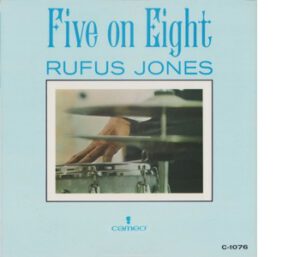 | September was another month of quite some purchases. Over 50 LP’s, a few 78rpm records and one EP, mostly from thriftstores and discount bins of record stores, I must admit – though I also bought a few new and much more expensive albums. To me, it’s fun to check the offerings and pick out stuff that somehow tickles my attention or curiousity. I come home with everything from classical to rock, from old time jazz to more modern variants, from Dvorak to Status Quo, from U2 to Rufus Jones. Rufus Jones? As a sideman drummer with only one album released under his name and leadership, Rufus Jones is not a household name for most jazz enthousiasts. However, he has an impressive track record, having played with Lionel Hampton, Maynard Ferguson, Count Basie, Woody Herman and Duke Ellington, among others. His only album as a leader, released under his own name on the Cameo label in 1964, is the album of the month. I found a NM copy of this album in a discount bin, totally unaware of who Rufus Jones was, and took it home because of curiosity, not because I was expecting much of it. However, the album surprised me with a number of cover versions (some from motion pictures) and a few tunes written by the pianist, Jaki Byard (probably most famous for his work with Charles Mingus). “Five On Eight” (referring to a 5/8 time signature) is a mono album, though there’s also a stereo version. It has to be filed under cool jazz, and the performances are nowhere very dangerous or uncomfortable, but ‘cool’ they are, cleverly performed by top musicians and very good sounding too, shifting from moody pieces to more uptempo material. Rufus Jones lays down the foundations with solid drumming, spicing up things with a few drum solo’s, most notable on “Just About That Time”. Other musicians include Tommy Turrentine (on trumpet, he was the brother of Stanley Turrentine), Joe Farrell (tenor sax), Teddy Smith (bass), Major Holley (bass), Seldon Powell (tenor sax) and Gene Bertoncini (guitar). I learned that Gene Bertoncini recently passed away, on August 29 of this year at the age of 89, leaving an impressive career behind him, both as a solo artist and a sideman. Other albums, bought this month and worthy to be mentioned here are the “Philip Glass/Cocteau Trilogy” by Katia & Marielle Labèque, “Very Tall” by the Oscar Peterson Trio with Milt Jackson, “Paco de Lucia interpreta a Manuel de Falla” by Paco de Lucia, and “Hello!” by Status Quo. |
|||
August 2026: Louis Jordan: Somebody Up There Digs Me
(Mercury MG 20242, 1957, USA mono, single slip cover)
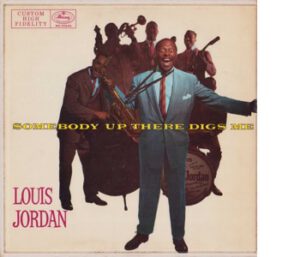 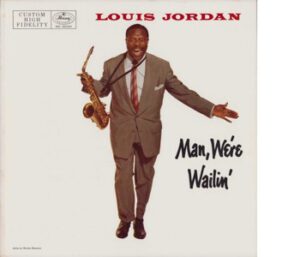 | A month of quite some Philips purchases (most filing under Classical) and more semi interesting stuff, but I also bought original copies of both Mercury LP’s of Louis Jordan, dating from 1957 and 1958. Louis Jordan was a favourite artist from the past when I listened almost exclusively to blues and rhythm & blues from the 1950’s. Jordan had his peak of creativity and sellability during the early 1940’s to the early 1950’s, when he (mainly) recorded for the Decca label. In the later 1950’s he recorded for Mercury and apart from a few singles, two LP’s were released: “Somebody Up There Digs Me” (1957) and “Man, We’re Wailin” (1958) – both shown at the left. The first of these two is the most interesting, especially because of the support of guitar player Mickey Baker. For “Man, We’re Wailin” Jordan hired organist Jackie Davis, who had a major impact on the sound, like Mickey Baker on the first album. On both albums, the material varies from rock & roll and rhythm & blues to more pop/novelty oriented stuff. Louis Jordan himself sings and plays the saxophone in his own inimitable way, not too serious but always driven. Other albums of more than average interest, bought in August, are Steely Dan’s “Can’t Buy A Thrill” and “Innervisions” by Stevie Wonder. On August 25th, Dolly Parton passed away, which needs to be mentioned here. I was only marginally interested in buying her music but I did appreciate her and what she stood for. From the few things I owned, only a 45 survived in my collection, an RCA single featuring “Mule Skinner Blues” (written by Jimmie Rodgers). RIP… |
July 2026: Edgar Varèse – Arcana, Intégrales, Ionisation
(Decca SXL 6550, Pure Analogue series, 1972/2026, Germany, numbered gatefold cover with insert)
  | July was a month of more record buying but less listening, due to being anywhere else but at home. I have not yet listened to all records I bought and the ones I listened to need more spins to be able to accurately evaluate them. But well, luxury problems, and I had to pick an album of the month anyway. The albums that made the most impression so far, were “Passin’ Thru” by the James Gang (70’s funky southern rock), “First Time Out” by the James Montgomery Band (70’s funky blues and southern rock), “Tyranny And Mutation” by The Blue Öyster Cult (70’s hard rock), “Paris Concert” by Gerry Mulligan (jazz) and, something completely else, Edgar Varèse’s “Arcana, Intégrales, Ionisation” (3 pieces) as performed by the Los Angeles Philharmonic Orchestra, conducted by Zubin Mehta (1971). This one became the album of the month. I knew Varèse (1883 – 1965) because he was an early influence to Frank Zappa, who learned to know Varèse through the album “Complete Works of Edgard Varèse” (EMS 401, 1951, pictured at the left). I found my copy of that album on Discogs years ago, there’s no special story to it, but Zappa’s story on how he found his copy is quite interesting, you can read it here. The recent reissue of “Arcana, Intégrales, Ionisation” in Decca’s Pure Analogue series and the review it got on Tracking Angle, made me order a copy from JPC. The Tracking Angle review says all (or most) there is to say about this album, so please go there for more information. From my listening session I can say that it is a weird and intriguing album, that sounds great (as it should, as it’s an expensive reissue). As I already knew from the EMS album, Varèse’s music is anything but easy or melodic or traditional. It files under Classical and it is indeed performed by a classical orchestra, but it’s experimental music in the first place. The pieces on this album were composed in the 1920’s and 1930’s, which makes it even more remarkable. Varèse explores borders, sounds and interactions in a way that’s quite unusual and it’s definitely not for everybody. For me it’s music for special occasions, when I’m in the mood for strange genius, when I can let go my usual preferences. It’s like looking at the paintings of an experimental artist, after having seen several examples of more traditional art. Though the uncommon is more accepted in a museum than on a record, it’s something similar, I guess; it wakes you up and it helps to put things in perspective… |
|||
June 2026: Angine de Poitrine – Vol. I and Vol. II
(Vol. I: Spectacles Bonzaï AP-01, 2024/2026, Canada, single slip cover with insert)
(Vol. II: Spectacles Bonzaï AP-02, 2026, Canada, single slip cover with insert)
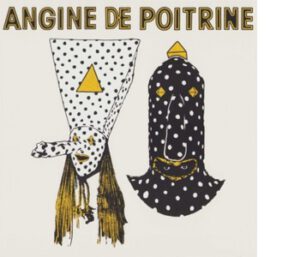 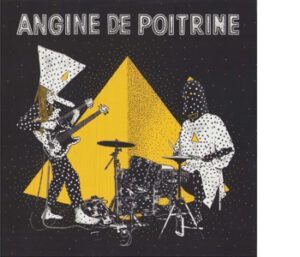 | In June, I only bought three albums; both Angine de Poitrine LP’s and “Keep Me Fed” by the Warning, a female hard rock trio (three sisters) out of Mexico. So, not too much to choose from this month, and a decision was even easier to make as the album by the Warning appeared not to be my cup of tea (despite the great live show of the Warning I saw on YouTube). I figured I could as well pick both Angine de Poitrine LP’s for this month’s album, as they are two sides of the same coin – they could as well have been released as a double album. Angine de Poitrine (from Canada) became an internet sensation through their KEXP performance on YouTube. That’s where I first saw them. I found them intriguing as for the music and very funny for both the music and their appearance. The two band members, Khn de Poitrine (guitar and bass on a combined double neck instrument) and Klek de Poitrine (drums and percussion) perform disguised in polka-dotted costumes and masks and their music draws from western and eastern influences melted together in a unique sound, in part due to the microtonal scales used by Khn de Poitrine. Take a close look to the fretboards of the guitar to see the differences with a common (bass) guitar. The music leans heavily on repetition, but it’s cleverly structured and it doesn’t get boring. Further more, it keeps you moving from start to finish. If anything can be labeled as new, as unheard before, in times where we think we’ve seen it all, this is it. And the fact that it looks and sounds like it doesn’t have to be taken too seriously, adds to the charm and to my appreciation for this band. Give it a chance, if you haven’t done so yet. Vol. I was first released in 2024 and original (early) pressings demand high prices. Vol. II followed in April 2026. In June 2026 both volumes saw a regular and worldwide release. |
|||
May 2026: Gabor Szabo – Spellbinder
(Impulse/Verve Vault A-9123, 1966/2026, EU, gatefold cover)
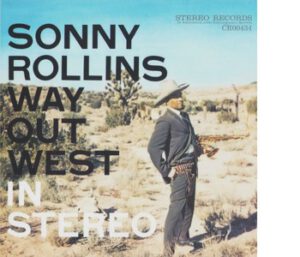  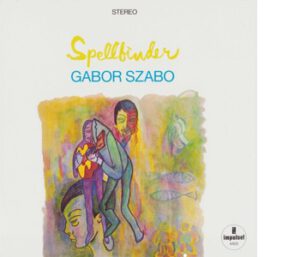 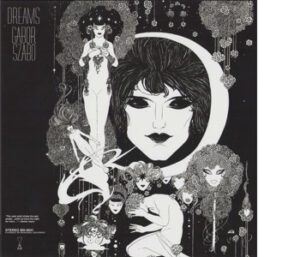 | In May 2026, the world lost one of its great jazz musicians and saxophone players: Sonny Rollins (Sept. 7, 1930 – May 25, 2026). Sonny Rollins definitely was one of my favorite jazz artists, especially for the “Way Out West” album (shown at the left), but his other albums, for as far as I know them, are cherished and appreciated very much as well. May you RIP! The album of the month is “Spellbinder” by Gabor Szabo, but before I get to that album, I ‘d like to pay some attention to Yusef Lateef’s album “Psychicemotus” – an original Impulse promo pressing in mono, which has been in my collection for several years. It could never be played because of heat damage and a severe warp. But… things changed and I can now play this album, which I find quite sensational! A big ‘thank you’ goes to the makers of the Pro-ject flattener for that. Some four or five years ago I took the album to a record store (Recordfriend in Amsterdam), which offered a flattening service for their customers. The man in service, with the appearance of a guru, looked at it and gave it back to me immediately, saying that nothing could be done to fix it. I got the feeling he judged me for being such an amateur to even ask. I never threw away the album, as it was a rare original, but I had no idea what to do with it. Last month I bought the Pro-ject “Flatten It” and the Yusef Lateef album was one that came to mind immediately. Because of the guru, whose message I took seriously, I had no hopes for any good results, but of course, I felt like giving it a try. Guess what happened… after the flattening treatment the album wasn’t only flat, it also played superb, with no audible traces left of the heat damage. This was not expected in any way and I found it to be quite sensational, like I said. I don’t think I will always be that lucky as heat damage will usually result in problems that can’t be solved, depending on how severe the damage is, f.i. how long it has been exposed to a heat source, but this felt like a miracle. On top of that, the album also appeared to sound extremely well. “Now, what kind of guru are you anyway?” (Frank Zappa) OK, back to what this page was intended for… May wasn’t a big spending month for records (it was the flattener!) and to pick the record of the month was difficult this time because of the small amount of good options to chose from! I could’ve chosen “Band On The Run” by Paul McCartney & Wings or “Together Again” by the Four Brothers (a jazz album) or the Analogue reissue of Bo Diddley’s first album (self-titled, Chess LP 1431). All fine albums but my first choice was “Spellbinder” by Gabor Szabo. Szabo was a Hungarian jazz guitar player who moved to the US in 1956, when he was around 20 years of age. He got much of his education there and what followed was a rich career, abruptly ended by his untimely death at the age of 45. He started the Skye Records label in 1968, with Gary McFarland and Cal Tjader. The first album by Gabor Szabo that I came to know was “Dreams“ (shown at the left), originally released on Skye in 1968; a great atmospheric album with Hungarian influences. Then I acquired an original mono promo copy of “Simpático” on Impulse (with Gary McFarland), which was a bit of a disapointment (it’s a vocal pop album), and then this month I bought “Spellbinder”, a reissue of his first true solo album, also originally released on Impulse (1966). It’s a good sounding album, issued in the new Verve Vault series, and musically much closer to “Dreams” than to “Simpático”, which is a good thing, as you will understand. The tunes are simple but effective, with one vocal track, a cover of “Bang Bang (My Baby Shot Me Down)”, originally done by Cher (and written by Sonny Bono, of Sonny & Cher fame). Another tune, “Gypsy Queen”, was made famous by Santana in 1977. Szabo had a style all of his own, characterized by hypnotic grooves and a matching guitar technique and tone (on an DeArmond amplified acoustic guitar). In the band are Chico Hamilton (drums), Ron Carter (bass) and Victor Pantoja and Willie Bobo (both on percussion). Except for Victor Pantoja, these gentlemen had all releases under their own names as well. Gabor Szabo can be found on a few Chico Hamilton LP’s (on Impulse). |
April 2026: Volker Kriegel – Inside: Missing Link
(MPS/BASF 33 21431-1, 1972, Germany, gatefold cover with built-in page)
 | Because of the record convention in Den Bosch, on April 10-12, it was an interesting month for buying records. I went to Den Bosch twice, on Friday and on Sunday, avoiding the crowdy Saturday. As usual, it was overwhelming, but not in a way that kept me from finding anything of interest. On the contrary, and to pick the most interesting album from the loot for April’s album of the month, was a challenge. Volkel Kriegel’s “Inside: The Missing Link” was chosen in the end, because of its appealing and varying complexity. Also worth mentioning: it’s a very good sounding album, a double album actually. The title of this album refers to the attempt that was made to create the ‘missing link’ between the European jazz scene and the rock music scene of the late 60’s and early 70’s. I didn’t know the album, nor the artist and bought it on a whim, but it appears to be considered a masterpiece, creating an innovative fusion of genres, made with top musicians of the day. I call it prog-jazz. I wondered if this album was still available as a reissue of some sort, and it is. In 2023 MPS reissued it on vinyl and there are some CD reissues on the market as well. Other albums of interest, purchased at the record convention, are “Way Out West” by Sonny Rollins (Contemporary; 1950’s US pressing, but the cover is missing), “Holiday In Brazil” by Bud Shank (World Pacific), “In The Right Place” by Dr. John (Analogue Productions) and “Blood On The Tracks” by Bob Dylan (CBS). |
|||
March 2026: Status Quo – Blue For You
(Vertigo 6360 128, 1976, Italy, single slip cover, no inserts)
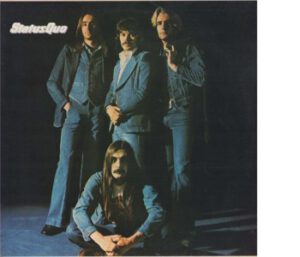 | I never realized how uplifting a good Status Quo boogie could be until I heard this 1976 album. Sure, I was charmed by what I owned of this band – not too much, two other albums actually (“Quo” and “On The Level“), but this one really hit me with songs such as “It’s A Fact” and “Mystery Song”. It can be considered as the last album of the original Quo boogie area, which started with “Ma Kelly’s Greasy Spoon” in 1970. The “Frantic Four” appear to be fading away in people’s musical interests, but I guess this isn’t correct as this band could play those relatively simple hard rock boogies with great conviction and fire. With one foot in the rock & roll days of the past and the other firmly planted in the 1970’s, it could still appeal to many younger listeners, if only they were aware. Status Quo has its own space in rock history and should be appreciated much more for that. The “Blue For You” pressing that I have, was made in Italy, and appears to be intended for the Dutch market. It’s a simple reissue, no gatefold and no lyrics innersleeve as with other pressings, though the innersleeve could have been lost. The sound is rather good, though one shouldn’t have audiophile expectations from any of this band’s recordings. Maybe a modern analogue treatment could do miracles, but I guess the time isn’t right for that yet. In the meantime I will buy more “Blue For You” pressings whenever I find them friendly priced, to see if some sonic improvements can be made. Other fine albums, bought this month, were: “Be Altitude: Respect Yourself” by the Staple Singers (Stax/Craft), “Dance Album” by Carl Perkins (Sun/Intervention) and “Close To The Edge” by Yes (Atlantic). |
|||
February 2026: Gentle Giant – Octopus
(Columbia 32022, 1972/7?, USA, single slip cover, no inserts)
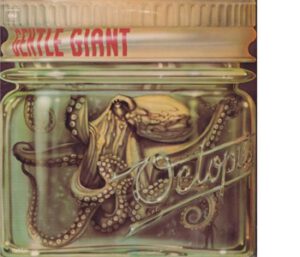 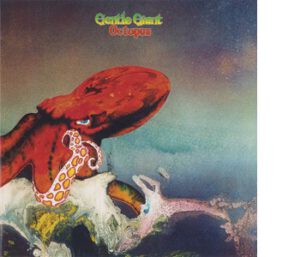 | “Octopus” by Gentle Giant is a masterpiece of progressive rock, blending intricate, polyphonic complexity with folk and classical influences. I already owned a recent reissue of this album (on Alucard, second image) and the one featured here as the album of the month, is an older American reissue, which I bought to compare the sound quality. It has a completely different cover, not half a as beautiful as the original European cover (by Roger Dean). For some reason I’m not always completely satisfied with the sound of Gentle Giant’s albums. I prefer the US album of “Octopus” above the Alucard reissue, as it appears to be more in balance, with slightly brighter sounding vocals. Steven Wilson worked on many of Gentle Giant’s albums, often improving on the sound quality, but for some reason he was not involved with the recent Alucard reissue of “Octopus”, even though his name is mentioned on the inside of the gatefold cover. Steven Wilson is working in the digital domain and though I appreciate the results, I would definitely welcome a true analog reissue program for essential Gentle Giant albums like the one reviewed here, “Free Hand” and “The Power And The Glory“. I didn’t buy too much this month, but worth mentioning is the CD box release “The Complete Véga Recordings 1956-1963” by Yvonne Loriod (13 CD’s, Decca). Though I’m not very much impressed with the sound quality, it gives a nice overview of the recordings of this classical pianist, who was married to Olivier Messiaen. Many works of Messiaen can be found here. |
|||
January 2026: The Dregs – Unsung Heroes
(Arista 203 630, 1981, Germany, single slip cover with printed innersleeve)
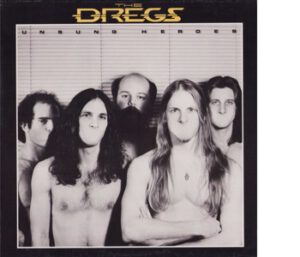  | The first album of the month is “Unsung Heroes” by the Dixie Dregs (as the Dregs here), from 1981. I already owned the first two solo albums by guitarist Steve Morse and especially the first (“The Introduction”, 1984) is one of my favorite instrumental albums (the second, “Stand Up”, that I have on CD, has several vocal tracks as well and fails to convince). It was about time to dive deeper in this man’s discography. The Dixie Dregs was the band Morse played in prior to his solo career, though the group reunited in the late 1980’s with new recordings made between 1992 and 2000. It appears they still perform. “Unsung Heroes” is a virtuoso instrumental album that showcases the band’s peak musicianship, combining jazz rock, rock, classical, and more. I love to hear songs like “Cruise Control”, “Divided We Stand”and “I’ll Just Pick”, to name just a few. Pretty much unbelievable what these gentlemen achieve here. In January I also bought “Night Of The Living Dregs” (1979) which is equally interesting. Their other albums are on my want list now. The covers for the Dixie Dregs albums leave much to be desired. Most are pretty ugly. The front cover presented here, made me think of the “Alarma” album by Daniel Amos (New Pax), also from 1981, which I have in my collection since my early days of collecting. On the Daniel Amos album, instead of blurred mouths, the eyes are blurred, as can be seen in the scan on the left. Also worth mentioning are both “cartoon cover” albums by the Sensational Alex Harvey Band (“The Impossible Dream” and “Tomorrow Belongs To Me“), which I bought this month as well – fine albums! |
|||